

DUCUG — Dutch Citrix User Group Conference #28 · Oude Duikenburg, Echteld, Netherlands · March 18, 2026 · 60-minute closing keynote.
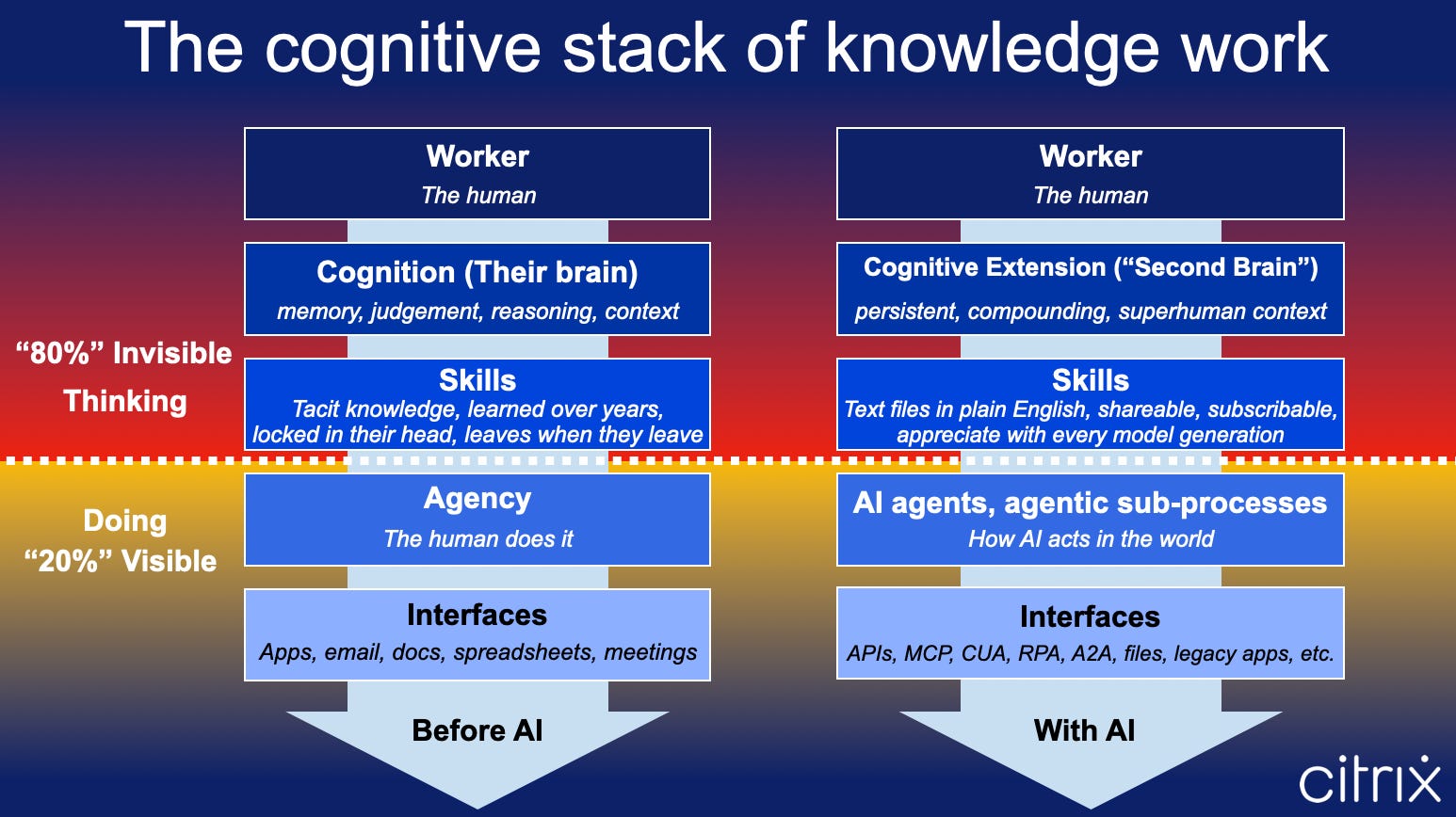
A complete overhaul of Brian’s stump speech, built from scratch in one day after the December 2025 version became entirely outdated following the November 2025 model inflection. The talk introduces the cognitive stack as a new framework for understanding AI’s impact on knowledge work, demonstrates Brian’s own second brain as a working proof point, and maps the governance implications to enterprise workspace management.
Enterprise AI fails because it targets the visible 20% of knowledge work — emails, documents, meetings — while the real value lives in the invisible 80%: thinking, judgment, reasoning. The November 2025 model inflection made it possible to build AI cognitive extensions that operate at the thinking layer. Brian built one and demonstrates it live, then walks down the cognitive stack layer by layer: skills, the irrelevance of automations, interface pathways, token economics, and why neutral workspace governance is the critical infrastructure need.
The paradox and the invisible 80%
Opens with the disconnect: workers love AI, companies see no ROI. The reason: companies invest in the visible 20% — Copilot, chatbots, automation — while the invisible 80%, knowledge, thinking, judgment, goes untouched. “If you only perfectly automate this little 20%, you’re missing the big part.”
November 2025 changed everything
Three frontier models — Opus 4.5, Gemini 3, GPT 5.2 — crossed key thresholds simultaneously: sustained hours of autonomous work, error recovery, reliable tool use. Not because the models got smarter per se — “it was all these little things that were annoying that prevented it from doing the work.” Practitioner reactions from Karpathy, Ford, Willison, and Cherny get shown as evidence.
Coding as canary for knowledge work
Everything happening to software developers is coming for knowledge workers within 18 months. The talk uses Nate B. Jones’s “Mad Libs” technique — swapping coding terms for knowledge-work terms — to make the parallel visceral.
The February convergence
A rapid-fire run of February 2026 headlines — Citrini, Fortune, WSJ, The Atlantic, the New York Times — all independently converging on “the disruption has arrived.” $285B of SaaS market cap evaporated. “It doesn’t say the AI disruption is coming. It says the AI disruption we’ve been waiting for has arrived. Past tense.”
The cognitive stack
Five layers: worker, cognitive extension, skills, agents, interfaces. It applies to all knowledge work, with or without AI. The top three layers, thinking, are invisible. The bottom two, doing, are visible. Enterprise AI investment concentrates at the bottom; worker adoption happens at the top. That mismatch is why companies see no ROI while workers love it.
The second brain in practice
Brian’s personal system: Claude Code connected to a folder of markdown files. He demonstrates a real morning session — Claude loads CLAUDE.md, follows links to thinking.md and a skills index, finds blog drafts, and has full context. The key insight: “I did not write this file. It wrote it for future versions of itself.” Model portability gets demonstrated too — when Claude went down, he switched to Gemini, and it worked immediately.
Skills
Skills are text files that tell AI how to do things. “Skills are sort of almost discovered as opposed to invented.” It isn’t engineering — “if you can write instructions for a colleague, you can write a skill” — and skills appreciate as models improve. Demonstrated real skills: connect the dots, daily briefing, podcast screenshot integration, work buckets.
The automations rant
“I hate automations.” Walking down the stack to agents, the talk subverts the audience’s expectation: “How repeatable are your jobs that you’re automating all this kind of stuff?” Automations are a bottom-of-stack concern. When you have the brain, the claws figure themselves out.
Interfaces: the four pathways
Modern apps via APIs and MCP. Web apps via browser control — demonstrated live, Claude controlling Chrome. Legacy apps via computer-using agents (OSWorld: humans at 72%, AI now at 75%). Direct file access. Agent-to-agent communication via shared folders. “Legacy applications is like all of them.”
Token economics
Real personal data: 285 million tokens consumed in about three weeks. Pre-second-brain: 100K tokens a day. Post: 5–10M a day. Subscription escalation from €20 to €200. Corporate API cost equivalent: roughly $954 a month. As a proof point, his AI built a usage dashboard live, in 4 minutes 27 seconds.
The token squeeze and governance
A 50–100x token increase per worker is coming once cognitive extensions go mainstream, and all compute capacity is already pre-sold through roughly 2030. Not all tokens are equal — every request has to be routed by complexity, sensitivity, and nature. The Excel routing example: the same task can cost 200K tokens via a computer-using agent or 1K tokens by reasoning in context. “Something needs to be making these decisions in real time for every worker, hundreds of times a day.”
Who decides
Not the worker — they don’t care about cost. Not Microsoft — they sell the tokens. Not the AI labs — they consume them. It requires a neutral party with workspace context. This is what Citrix does, and has done, for 35 years.
Key formulations
“I can AI the crap out of this, I can do it perfectly. And I still haven’t really changed the way the thinking happens, which is where all the money is.”
“Skills are sort of almost discovered as opposed to invented.”
“Which half of my job do you want me to not do?”
“The company that spends the most tokens in the most smart way is going to win.”
“Your offspring, grandchild AI is going to be reading these folders someday. Make it really good instructions.”
“This is not something that’s coming into knowledge work. This is here and available now.”